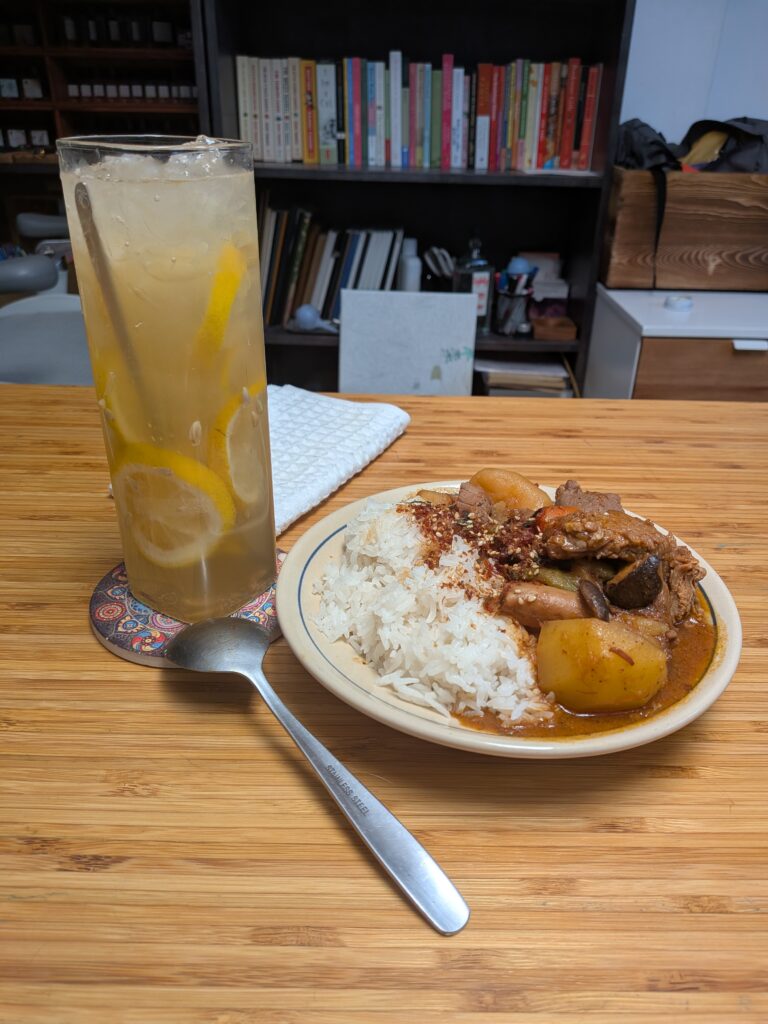
I can eat the same dish for a long time. I used to eat at the same stalls or restaurants every day for months. And when cooking, I like to cook a huge batch to eat over multiple days. This is especially common whenever I live alone. It’s less about the efforts saved by cooking once for multiple meals. It’s more about the safety anchor of knowing I have a meal a few minutes away from readiness at home.
The most common is braised pork and eggs. The same dish we usually have for Lunar New Year because it can last days with proper care. When I learnt how to keep herbs fresh for a long time in the fridge, I started to have enough spring rolls’ ingredients prepared for one whole week, and just wrapped some whenever I felt like to.
And then there was curry.
I didn’t eat a lot of curry growing up. I started to eat a lot of curry when I chanced upon a really good tonkatsu place. I made it myself, adding some ingredients here and there until I was happy. It became my favorite dish to cook for five reasons.
First, it is an easy win. It’s hard to fuck up curry and there are easy fixes for all kinds of incidents. Too salty, too sweet, too thick, too thin, etc. Even slightly burned (which actually is very common when making curry), it adds some flavors.
Second, it is flexible. There are a few key ingredients then the rest is just depending on your mood, the selections at the grocery stores, or some adventurous trials. And it is very tolerate of the ingredients. You don’t need the best quality stuffs. You can get misshaped potatoes, the ugliest carrots, and almost any chunks of proteins. No big concerns as long as they are not spoiled. It is indeed the best way to use overripe tomatoes.
Third, it is simple and effortless. The actual effort is very little because the main cooking part is the simmering, which require minimal levels of attentions. The preparation is fairly basic and there are multiple ways to optimize such as buying pre-diced veggies.
Fourth, it is better on the second day, and even more so on the third day. The fresh curry is the headliner for the band you buy the concert tickets for.
Fifth, it freezes really really well. Possibly the best dish to freeze. So any leftover curry can be frozen for two or three weeks and can be heated up to eat with no problem. And you can make the curry base with no protein and store them for a whole month.
Altogether I never had any major concern about making a really big batch of curry. Then there was that month when I barely needed to leave my house. The curry wasn’t even put into the fridge. I just kept the pot on the stove simmering most of the time. I had curry 3 – 4 times a day whenever I wanted to.
That was the begin of my almost forever curry.
For context, perpetual stew, also known as forever soup, is a pot where we keep adding foods and cooked continuously sometimes for decades or longer. Something that supposedly happened in medieval inns.
I didn’t have it going for decades. But I did have it going for months. I kept adding carrots, apples, potatoes, and whatever veggies I liked. I found out bitter melon and eggplants are actually really good in curry. Then for the proteins, most of the time it was beef. No high quality cut. Instead, I would ask the butchers for the scraps from cutting and trimming or offcuts. Chickens fit really well, drumsticks, thighs, or wings. And of course, eggs.
There were only two main things to take notes of to assure a persistent flavor:
- First is to keep the proteins from the main base pot. Mainly to not find a piece of chicken from last week in your beef curry of the day and unlike the vegetables, the flavors of the proteins do not mix well with each other.
- Second, seasonings whatever ingredients you add, especially the proteins. Don’t add extra seasonings to the base unless you also add liquid. If it’s beef or pork, give them a quick stir-fried to brown them a bit. If it’s chicken, put them in the air fryer for 5 – 10 minutes. For the veggies, mix them with some spices, and fried them in hot oil for a few mins to activate the spices.
So for 4 months, more a less, I ate nothing but curry and rice. I am not sure if it was healthy, but it was definitely hearty.
How to make curry
Ingredients:
- Proteins:
- Beef: Seasons lightly with salt, pepper, garlic, oyster sauce, soy sauce, and honey.
- Pork: Seasons lightly with salt, pepper, garlic, and oyster sauce.
- Fish: Seasons lightly with fish sauce, salt, and pepper
- Chicken: Brine an hour or two in water mixed with some salt, pepper, lime, onions, and bay leaves
- Acidic:
- Diced Tomatoes, Tomatoes Paste, Ketchup, Chili Sauce. You don’t need all of them, but using different sources of tomatoes give some layers of flavors.
- Vegetables:
- For starch: Potatoes as the default (Choose the more starchy types). Other good options are sweet potatoes and pumpkins. Cut into decent size chunks.
- For sweetness: Carrots as the default, cut into decent sizes. Apples are extremely good but more like icing on the top. Usually people would dice the apples, but I prefer to cut them to chunks.
- Good ratio is 3 parts of starchy vs 1 parts of sweetness.
- Others: Any veggies that is suitable for a stew is good here. Mushrooms are always a welcome addition. I really like adding bitter melon.
- If cooking for myself, I would also add as much ớt sừng Ba Tri (Ba Tri chilly pepper) as I can tolerate. Usually this means I would be the only one who can eat it though.
- Spice, seasonings, and fragrance:
- Onions, garlic, and a tiny piece of ginger. If you have time, caramelize half the onions for extra flavors.
- Pre-mixed Curry pack with some curry leaves.
- Five Spice Powder
- (Optional) Miso
- Chocolate
Cooking:
- Base:
- Mix the veggies with the spice.
- Heat up the pot and add some oil. Add the garlic and other fragrances. Cook in very slow heat to extract the aroma.
- Add the veggies, turn the heat to med-high. Add some salt and stir-fried well for a few minutes, then turn to medium when the oil starts to separate.
- Add water to cover and add all the different versions of tomatoes. Turn up the heat til boiling, then simmer at low heat. If you have a good pot, you can also turn off the heat, put a lid on, and leave for an hour for them to cook.
- The curry base is ready when the starch starts to come out and thicken the sauce by themselves. You should not need to add any thickening like flour or corn starch.
- Add a small piece of dark chocolate and stir well til melted.
- Add the proteins when ready.
- Seasoning to taste.
- (Optional) Mix the miso with some water. Add right before turning off the heat for serving. Don’t add them during cooking, the miso flavor will be lost quickly.
- Proteins:
- Heat up a pan and add some oil. Add garlic and simmer a bit in the oil to extract the flavor.
- Turn up the heat, add the proteins and stirred fried well.
- Add the proteins to the curry base and cook in slow heat for as long as possible. For meat, it would require 45 – 60 minutes to break the flavors out, more for beef. Fish should not be cooked for too long.
- For eggs, just boil til well done, peel, and add them to the curry base.
- To save time, you can stir fried some thinly sliced beef or pork and serve directly on top of the curry base without having to wait. Those are more expensive cuts though.
The curry base before adding the proteins can be frozen for use later. Adding the protein then freezing the curry can lead to some odd tastes.
The simplest version of the curry would require:
- Garlic and onions
- Beef (offcuts) or eggs
- Diced Tomatoes
- Chunks of potatoes and carrot
- Curry Powder
- Oil, salt, pepper
This is best served with rice. Add some flakes for extravagance. Can be eaten as is (given it already has lots of starch from the potatoes) or with bread as well.